It’s 1970 . Bill Blosser and I , two twenty-somethings, are the proud owners of a dilapidated orchard in the Dundee Hills, which we will clear to start our vineyard. That we have no business experience, no farming experience, no winemaking experience, and that we choose to locate in Oregon which has no wine industry, does not dissuade us one bit.
Our lack of experience might have been a handicap, but our youth was an advantage. What did we have to lose? Mainly time and energy and we had that. So we plunged ahead, with no idea what would happen.
So the fact that we’re still here, 56 years later ,should give all budding entrepreneurs hope.
From the start, people always asked me what led us to do this crazy thing.
I didn’t quite understand it myself, so I’d simply say “We had more guts than brains.”
I have better perspective now. To understand the beginning of the Oregon wine industry, look at when it started—1965-75—the decade that included the Vietnam War, Watergate, the Iran hostage crisis, more than one political assassination, and race riots.
But this is also the period when Microsoft, Apple, and Starbucks launched. The air was super charged with out-of-the box thinking in every arena. This is when Julia Child taught us a new way to cook and the Beatles transformed rock and roll.
It was in this maelstrom of creative entrepreneurial activity that the Oregon wine industry was born. Bill and I, along with a handful of other young couples, were part of that transformative energy.
And look what we started. One generation later, Oregon wine is internationally recognized, with over 600 wineries pumping 8 billion dollars into the Oregon economy.
But of our handful of founding wineries, only two that export have stayed in the family and are operated by the second generation. I’m proud to say Sokol Blosser is one. Elk Cove is the other.
Right now, Oregon wineries are facing headwinds from multiple directions. Just to name two: our substantial export market dried up with Trump’s tariffs. And both the World Health Organization and the Oregon Health Authority, are actively preaching anti alcohol.
But wine is not going away. It’s heritage is ancient and global and countries are speaking up about it. After declaring wine a “living culture,” Uruguay began a governmental initiative to integrate cultural policy, industry strategy, and international diplomacy. I find this significant as wine from Uruguay is not generally known internationally.
But in the better known wine world, the Italian Minister of Agriculture, in a recent speech to a large European audience, explained why wine is not about alcohol delivery, but rather about culture and community.
“Inside that bottle of wine on your table,” he said, “there is land, culture, work, enterprise, identity, and tradition.”
And that is exactly how the Sokol Blosser family looks at what we do.
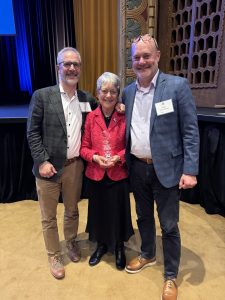
I am honored to have been singled out for the Ambassador Award. I’m proud to accept it, not only for me, but for the other women in our early cohort who contributed just as much as the men but got no recognition.
Thank you to the Oregon Consular Corps for acknowledging the contribution that the Oregon wine industry has made to Oregon culture and community… And recognizing that women have been part of that.